← Blog · 22 July 2026 · Bureaucracy · Citizenship · Money
Bürgergeld Is Gone: What Germany's New Grundsicherungsgeld Means If You're Not a Citizen Yet
Germany replaced Bürgergeld with Grundsicherungsgeld on 1 July 2026: stricter savings rules, faster sanctions, and a link to your citizenship application.
If you've been in Germany long enough to hear the word Bürgergeld, you can retire it. As of 1 July 2026, the benefit is officially Grundsicherungsgeld ("basic security money"), the centerpiece of a reform the Bundestag passed on 5 March 2026 and the Bundesrat approved on 27 March (Bundesregierung). The rename is the headline, but the parts that actually matter if you're an immigrant or international student are the rule changes riding along with it, and one of them reaches directly into your citizenship timeline.
What actually changed on 1 July
The reform (the 13th SGB II Amendment Act) resets the relationship between the state and jobseekers around three ideas: faster placement into work, less patience with missed appointments, and a smaller savings cushion before you're expected to spend your own money first.
Job-placement priority is back. Caseworkers are now instructed to check first whether you can be placed into a job quickly; training or further qualification comes second, not first, with softer treatment for people under 30 (BMAS).
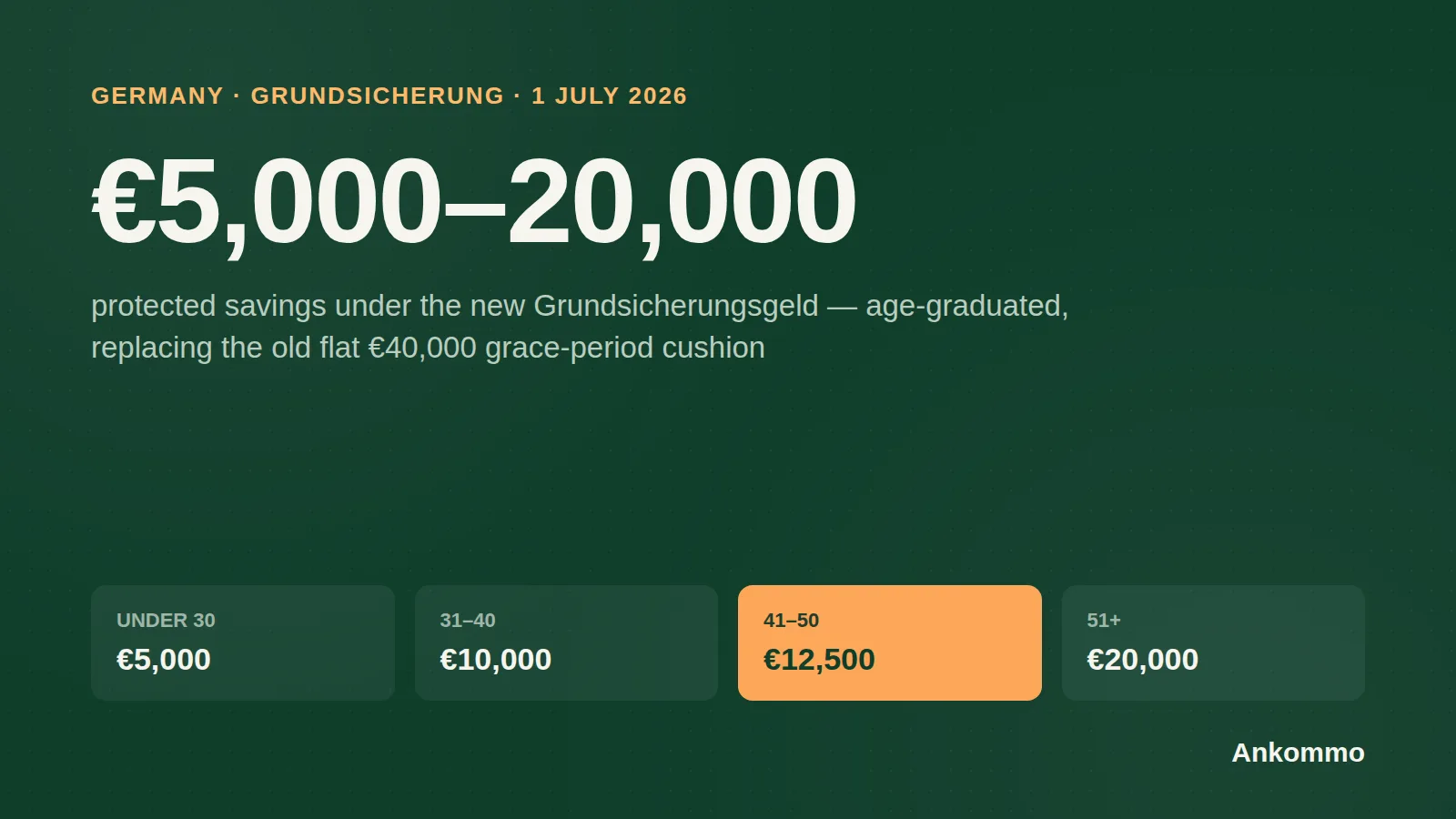
The savings grace period is gone. Previously, new claimants got a one-year "Karenzzeit" during which up to €40,000 in savings was protected outright, regardless of age. That flat allowance is abolished. In its place, an age-graduated limit applies from day one of a new claim: €5,000 if you're under 30, €10,000 from 31, €12,500 from 41, €20,000 from 51 per person in the household. If you already had a claim running before 1 July 2026, you keep the old grace-period rules until that approval period ends; this only bites on new applications.
Missed appointments cost you faster. Jobcenter appointments skipped without an excuse now trigger quicker benefit reductions than under the old Bürgergeld sanction rules.
The standard rate itself didn't move. For once, that's good news by omission: 2026 is a "Nullrunde", a zero round. The statutory adjustment formula, tied to price and wage growth, produced no increase, so the standard rate for a single adult stays at €563 a month, the same as under Bürgergeld in 2025 (Bundesregierung).
Why this isn't just a German-worker story
If you're on a visa that doesn't touch the jobcenter system at all (a Blue Card, most skilled-worker routes, a stable Ausbildung contract), this reform mostly passes you by. It matters the moment your situation gets less stable: you lose a job partway through a residence permit, you're a student whose part-time hours dried up, or you're the accompanying spouse of someone whose employment fell through. Anyone who ends up filing an SGB II claim for the first time after 1 July walks straight into the new, smaller savings allowance, not the old €40,000 cushion long-timers might remember reading about.
The part that actually changes your citizenship plan
This is the detail worth sitting with. §10 of the Staatsangehörigkeitsgesetz (Nationality Act) requires you to secure your own livelihood (for yourself and your dependents) without drawing on Bürgergeld/Grundsicherungsgeld or social assistance, before you can naturalize (Gesetze im Internet). That requirement didn't arrive with this reform; it's the same livelihood gate that's been tightened since the 2024 citizenship law changes. But the rename doesn't reset the clock or soften the rule: a Grundsicherungsgeld claim blocks a citizenship application exactly as a Bürgergeld claim did.
The residence-time clock keeps running regardless: five years of lawful residence toward standard naturalization still accrues while you're on the benefit. What you can't do is submit a successful application while you're drawing it, outside narrow exceptions (for example, where the need wasn't something you brought on yourself). If your household finances are close to the edge and citizenship is on your radar, this is exactly the kind of detail to check with your Ausländerbehörde or a Sozialrecht-specialized advisor before you assume you're eligible; see Ankommo's citizenship timeline calculator for how the residence math and the livelihood requirement interact, and Ankommo's breakdown of the §10 StAG livelihood rule for the 20-of-24-months exception that can waive it outright.
EU citizens: the five-year rule hasn't changed
If you're an EU citizen and you haven't worked in Germany or built up entitlements through prior employment, you generally have no claim to SGB II or SGB XII benefits during your first five years of residence if you're here purely to look for work. That line survives the reform untouched: the rename affects the benefit's mechanics, not this exclusion. After five years of lawful, continuous residence, the exclusion falls away and you're treated the same as anyone else in the system.
What to actually do if this touches you
- Check your claim date. If your Bürgergeld approval period was already running before 1 July 2026, you keep the old €40,000 grace-period allowance until that period ends. Don't panic and start moving savings around based on rules that don't yet apply to you.
- If you're filing a new claim now, know your age bracket's protected-savings figure before you apply, so there are no surprises about what counts against you.
- If citizenship is on your timeline, treat any Grundsicherungsgeld claim as a pause button on your application, not a rule that quietly doesn't apply to you because the benefit changed its name.
- If you're an EU citizen job-hunting, don't assume access to benefits during your first five years. Plan your finances as if the exclusion applies, because it almost certainly does.
Related on Ankommo
- Citizenship Timeline Calculator
- B1 German for Citizenship
- Working in Germany: salary, tax and payslip tools
Figures verified against the official sources below as of July 2026. Benefit and immigration rules change, so always confirm your own situation with your Jobcenter or Ausländerbehörde before making decisions.
Frequently asked questions
Is Bürgergeld still called Bürgergeld in Germany?+
No. Since 1 July 2026 the benefit is officially called Grundsicherungsgeld, part of a broader reform of basic income support for jobseekers (SGB II). The underlying rules on who can claim it haven't been rewritten from scratch, but several details (savings limits, sanctions, job-placement priority) changed alongside the name.
Can I get German citizenship while receiving Grundsicherungsgeld?+
Generally no. §10 of the Nationality Act (Staatsangehörigkeitsgesetz) requires you to secure your own livelihood without relying on Bürgergeld/Grundsicherungsgeld or social assistance, with narrow exceptions (for example if you're not responsible for needing the benefit, such as short-term involuntary unemployment in specific circumstances). Time served toward the 5-year residence requirement still counts even while you're not eligible to naturalize yet; you just can't submit a successful application until you're off the benefit.
Do EU citizens get Grundsicherungsgeld the same way as German citizens?+
Not automatically. An EU citizen living in Germany purely to look for work, who hasn't yet worked there or built up entitlements through prior employment, generally has no claim to SGB II or SGB XII benefits for the first five years of residence. After five years of lawful, continuous residence, that exclusion falls away.
Sources

Guide by
Abdullah
Creator of Ankommo · Based in Germany
I moved to Germany and built Ankommo to help others navigate the same process I went through. We offer 1-on-1 video consultations on visas, Ausbildung applications, citizenship requirements and settling in.
Book a 1-on-1 consultation