← Blog · 19 July 2026 · Working in Germany · Money · Students
Germany's Minimum Wage in 2026: €13.90 an Hour and What It Means for You
Germany's statutory minimum wage rose to €13.90 an hour on 1 January 2026, with €14.60 scheduled for 2027. What that changes for workers and students.
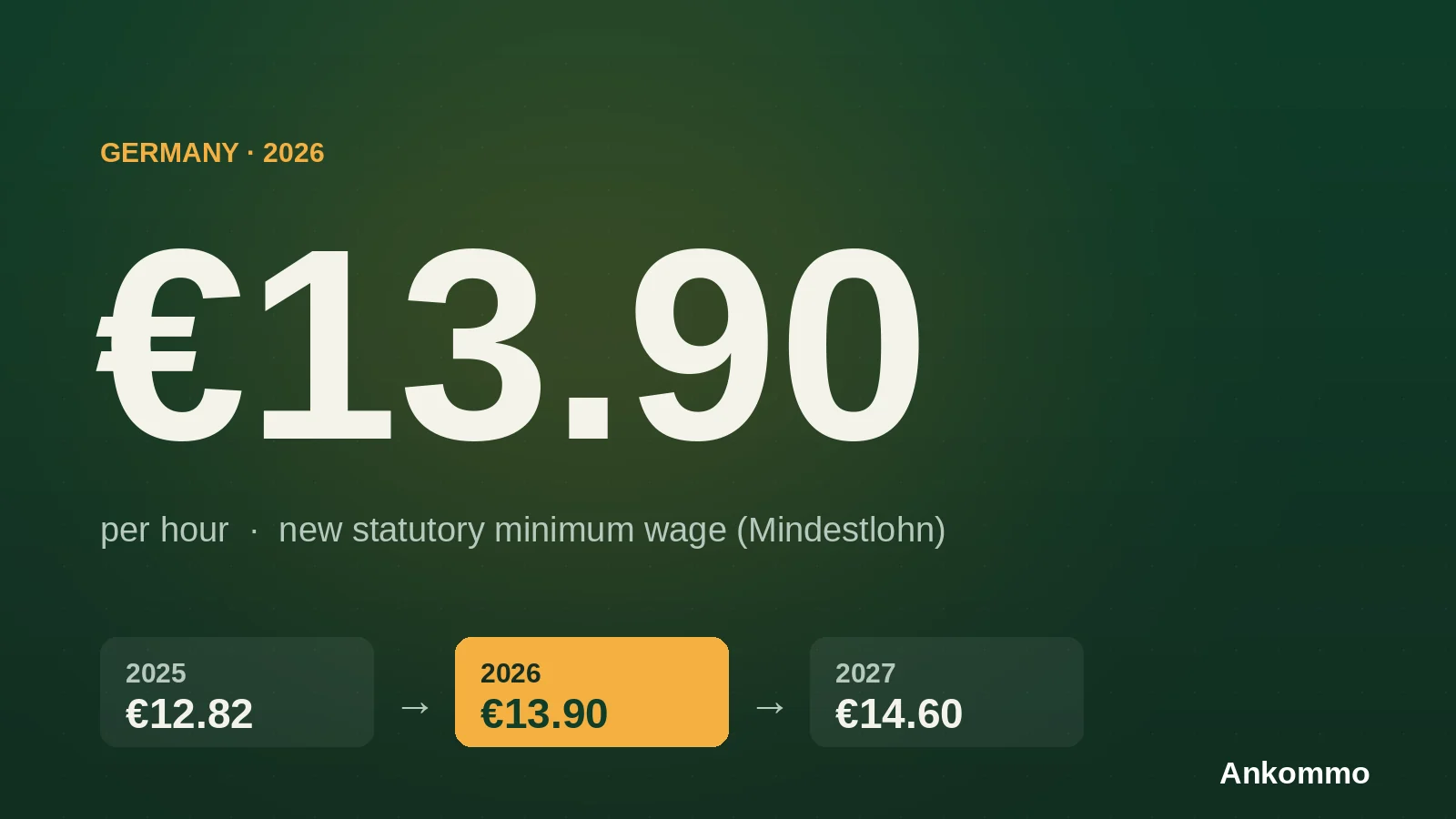
If you work in Germany, your hourly floor went up on 1 January 2026. The statutory minimum wage (gesetzlicher Mindestlohn) is now €13.90 gross per hour, up from €12.82. That's an increase of €1.08, or about 8.4%. And it isn't the last step: a further rise to €14.60 is already locked in for 2027.
Here's what actually changes for workers, students, and mini-jobbers, and how to check you're being paid what the law requires.
The new rate, and the step still to come
Germany's minimum wage moves in fixed steps recommended by the Minimum Wage Commission (Mindestlohnkommission), a body of employer, union, and academic representatives. The current schedule is a two-stage increase (Mindestlohnkommission):
- 2025: €12.82 per hour
- 2026 (from 1 January): €13.90 per hour
- 2027 (from 1 January): €14.60 per hour
This is the largest jump since the national minimum wage was introduced in 2015. It applies across the whole country and to almost everyone in regular employment: full-time, part-time, and mini-jobs alike.
What it means for mini-jobs
The mini-job earnings limit isn't a fixed number. Since 2025 it has been dynamically tied to the minimum wage, set at the value of roughly 10 working hours per week. So when the wage floor rose, the mini-job ceiling rose with it:
- 2025: €556 per month
- 2026: €603 per month
- 2027: €633 per month
At €13.90 per hour, a mini-jobber can work about 43.4 hours per month (around 10 hours a week) before crossing the €603 ceiling into a Midijob, where social-security contributions start to phase in. If your employer keeps your hours the same as last year, your monthly pay should have gone up; if they keep your pay the same, they should have cut your hours slightly to stay under the limit.
What it means for international students
For students, the minimum wage matters twice over, because part-time work is how many international students cover their living costs.
- It applies to you. Nationality makes no difference: a student on a residence permit doing a mini-job or a Werkstudent (working-student) role is entitled to at least €13.90 per hour, the same as anyone else.
- Watch your day limit, not just your pay. A student residence permit generally allows 140 full days or 280 half days of work per year outside your studies. A higher hourly wage means you reach a given income target in fewer hours. That helps, because your binding constraint is often days worked, not euros earned.
- The mini-job ceiling is your tax-simple zone. Staying under €603 a month keeps you in mini-job territory, where the paperwork is lightest. Earn more and you move into a Midijob, which is still fine but changes how contributions are deducted.
If you're still working out how a German payslip turns gross pay into take-home, our working in Germany guide breaks down every deduction line, and the salary calculator shows your net for any gross figure.
Who doesn't get the minimum wage
A few groups are legally exempt under the Minimum Wage Act (MiLoG). The main ones (Mindestlohnkommission):
- Apprentices (Auszubildende). Vocational trainees are paid a separate training allowance (Ausbildungsvergütung) set under the Vocational Training Act, not the minimum wage.
- Under-18s without a completed vocational qualification. The wage floor doesn't apply to minors who haven't finished a recognised training programme.
- Certain interns. Mandatory internships required by a school or university, and voluntary orientation internships of up to three months, are exempt. A longer voluntary internship generally does qualify for the minimum wage.
- The long-term unemployed, for the first six months after returning to work.
If you're doing a paid working-student job or a normal part-time job, none of these apply: you should be on at least €13.90.
How to check you're being paid correctly
The simplest test: divide your gross monthly pay by the hours you actually worked. If the result is below €13.90, your employer is underpaying you, and that's enforceable; the minimum wage is a legal floor, not a guideline. Keep your own record of hours worked, since that's what you'll need if there's ever a dispute. If you signed your contract from abroad and started work in 2026, your employer was legally required to hand you contact details for free, confidential wage-and-contract advice before your first day.
For the bigger picture of what your role should pay beyond the legal minimum, the average salary in Germany guide benchmarks real market pay by profession, experience, and region.
Related on Ankommo
- Working in Germany guide: contracts, payslips, and what gets deducted from your gross pay
- Salary calculator: turn any gross salary into monthly net take-home
- Average salary in Germany: what your profession actually pays across the country
- EU Blue Card Germany 2026: the salary thresholds for the skilled-worker fast track
Frequently asked questions
What is Germany's minimum wage in 2026?+
The statutory minimum wage (gesetzlicher Mindestlohn) is €13.90 gross per hour, in force since 1 January 2026. It went up from €12.82 in 2025: a rise of €1.08, or about 8.4%.
Will the minimum wage rise again after 2026?+
Yes. A second step is already fixed: the minimum wage rises to €14.60 per hour on 1 January 2027. Both increases follow the Minimum Wage Commission's recommendation.
Does the minimum wage apply to international students working part-time?+
Yes. The minimum wage applies regardless of nationality, so a student in a normal part-time job, mini-job, or Werkstudent role must be paid at least €13.90 per hour. The main exceptions are apprentices, certain interns, and under-18s without a completed vocational qualification.
How many hours can a mini-jobber work in 2026?+
The mini-job earnings ceiling rose to €603 per month in 2026 because it is tied to the minimum wage. At €13.90 per hour, that works out to about 43.4 hours per month (roughly 10 hours a week) before you cross the mini-job threshold.
Sources

Guide by
Abdullah
Creator of Ankommo · Based in Germany
I moved to Germany and built Ankommo to help others navigate the same process I went through. We offer 1-on-1 video consultations on visas, Ausbildung applications, citizenship requirements and settling in.
Book a 1-on-1 consultation