← Blog · 21 July 2026 · Immigration · Work in Germany · Skilled Workers
Germany's Recognition Partnership Visa: Work First, Get Your Qualification Recognized Later
Germany's recognition partnership visa lets skilled workers move, start working, and get their foreign qualification recognized afterward.
If your job back home doesn't have a tidy German equivalent (you're a nurse trained under a different curriculum, an electrician with a certificate that doesn't map onto the German system, or an engineer whose degree needs checking against a German one), the usual advice is to get your qualification recognized before you apply for a visa. That process can take months, sometimes over a year, and it happens while you're still abroad, unemployed, with no income from the job you're qualified to do.
The recognition partnership (Anerkennungspartnerschaft) exists to remove that wait. It's a legal pathway that lets you enter Germany, start working, and finish the recognition procedure afterward, with your employer on the hook to help you get there.
The basic idea
Under §16d(3) of the Residence Act (AufenthG), you don't need a completed equivalency decision to get a visa. Instead, you need:
- A foreign qualification: either a vocational qualification that required at least two years of training, or a recognized university degree from your training country.
- A concrete job offer in Germany connected to that qualification.
- A written recognition partnership agreement with your employer, committing them to support you through the recognition process, for example through additional training, exams, or supervised on-the-job qualification.
- German at CEFR level A2 or above, proven by a certificate (Goethe-Institut, telc, or a comparable provider are generally accepted).
Your employer isn't just signing a job contract: they're signing up to actively help close the gap between your foreign qualification and the German standard. That requirement filters for employers who already have real experience running training or upskilling programs, which is exactly who you want backing you through this.
How long you get, and what has to happen in that time
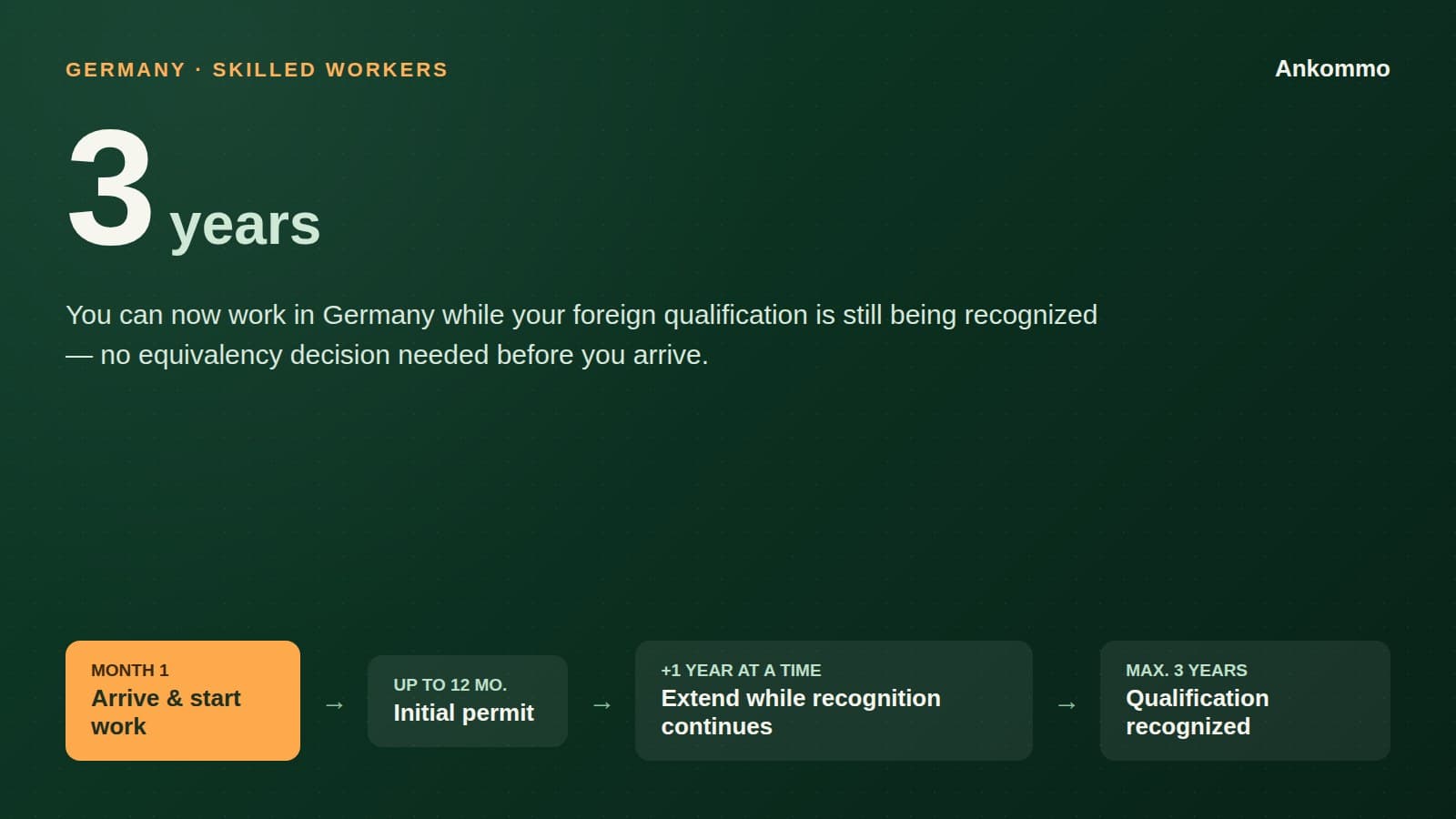
The residence permit is issued for up to 12 months initially, and can be extended by up to one year at a time, for a maximum of three years total. The recognition procedure has to be completed within that window, while you're already working and earning.
This is a meaningfully different structure from applying for recognition from abroad, where the clock doesn't start until the decision arrives and you have no income in the meantime. Here, the clock and your paycheck start on the same day.
You can work extra hours, too
On top of the job tied to your recognition partnership, you're allowed up to 20 hours a week in secondary employment. For anyone budgeting a first year in a new country (deposit, moving costs, the gap before the first full paycheck clears), that's a real cushion, not a footnote.
How to apply
The mechanics run through the German mission in your home country, not an office inside Germany:
- Have your qualification assessed against the German equivalent, so you know exactly what's missing before you commit to a plan.
- Find an employer willing to enter a recognition partnership and sign the agreement with them, spelling out how they'll support the remaining training, exams, or supervised practice.
- Book an appointment and apply at the German embassy or consulate responsible for your place of residence, with your employment contract, the recognition partnership agreement, your A2 language certificate, and certified translations of your qualification documents (Ankommo's certified translation guide covers what a diploma or work reference translation actually costs).
Processing times vary by mission and by profession (nursing, in particular, has additional fast-track handling in some cases), but the structure of the application is the same across occupations.
Where this fits among your other options
If your degree or training already has a clean German equivalent and you clear the salary bar, the EU Blue Card is usually faster and simpler: no employer training commitment required, and a shorter path to permanent residency once you're B1 in German. The recognition partnership is specifically for the case the Blue Card doesn't cover well: your qualification itself needs work before it counts as equivalent, and you'd rather do that work in Germany, employed, than abroad, waiting.
It also isn't the only "come and sort it out here" route; the Chancenkarte points-based job-seeker visa is built for people without a job offer yet. The recognition partnership assumes you already have one, and trades the search phase for a structured, employer-backed recognition timeline instead.
The bottom line
If a recognition gap is the only thing standing between you and a job you're qualified for, the recognition partnership turns "wait abroad for a decision" into "start working in Germany while the decision catches up", with a hard three-year ceiling that keeps the process honest. A2 German is the real gatekeeper here, and it's worth having solid before you start collecting documents.
Related on Ankommo
- EU Blue Card Germany 2026: Salary Thresholds & the Fast Track to PR
- B1 German for Citizenship
- Germany Visa Checker
- Certified Translation in Germany: What It Costs
Figures verified against the official sources below as of July 2026. Immigration rules change, so always confirm against the linked official pages before making decisions.
Frequently asked questions
What is a recognition partnership (Anerkennungspartnerschaft) in Germany?+
It's a residence permit under §16d(3) of the Residence Act that lets you move to Germany, start working, and complete the recognition of your foreign vocational qualification or degree afterward (with your employer's support) instead of waiting for a recognition decision before you arrive.
How long can I stay in Germany on a recognition partnership?+
The permit is issued for up to 12 months at first and can be extended by up to one year at a time, to a maximum of three years total, which is how long you have to complete the recognition procedure.
Do I need to already speak German for a recognition partnership?+
Yes. German at CEFR level A2 is required before you apply, which is lower than the B1 most other skilled worker routes eventually require, but still a real bar. It's usually the first thing to sort out before you start the visa process.
Sources

Guide by
Abdullah
Creator of Ankommo · Based in Germany
I moved to Germany and built Ankommo to help others navigate the same process I went through. We offer 1-on-1 video consultations on visas, Ausbildung applications, citizenship requirements and settling in.
Book a 1-on-1 consultation