← Blog · 16 November 2026 · German CV · Lebenslauf · Job search
Gaps in a German CV: How to Name Every One
German recruiters expect a CV without unexplained holes. Which gaps to name, the one-line German wording for each, and where to explain the rest.

Name every break of more than two months in one plain line, in the same dates column as your jobs. That is what the lückenloser Lebenslauf, the gap-free CV German recruiters expect, means in practice: not a career without pauses, but a timeline where every month is accounted for.
The Federal Employment Agency (Bundesagentur für Arbeit) gives the same advice in its own guide to the CV. It asks applicants to state breaks of more than two months and what they did in them, and it says that dealing with gaps openly matters more than hiding them.
What "lückenlos" means, and what it does not
A German CV runs in reverse order with the dates in their own column, so every hole between two entries is visible at a glance. "Lückenlos" (without gaps) asks for one thing: that each of those holes is labelled. It does not ask for a job in every month.
Three rules make it work:
- Write dates as MM/YYYY. Years alone hide gaps and create false ones. "2019 to 2021" next to "2021 to now" looks seamless on paper and still prompts the question "which months?".
- Two months is the safe line. A few weeks between two jobs is part of normal life, but the Bundesagentur draws the line at two months, so treat anything longer as a gap to name.
- One line per gap. A neutral label and the dates. No apology, no paragraph.
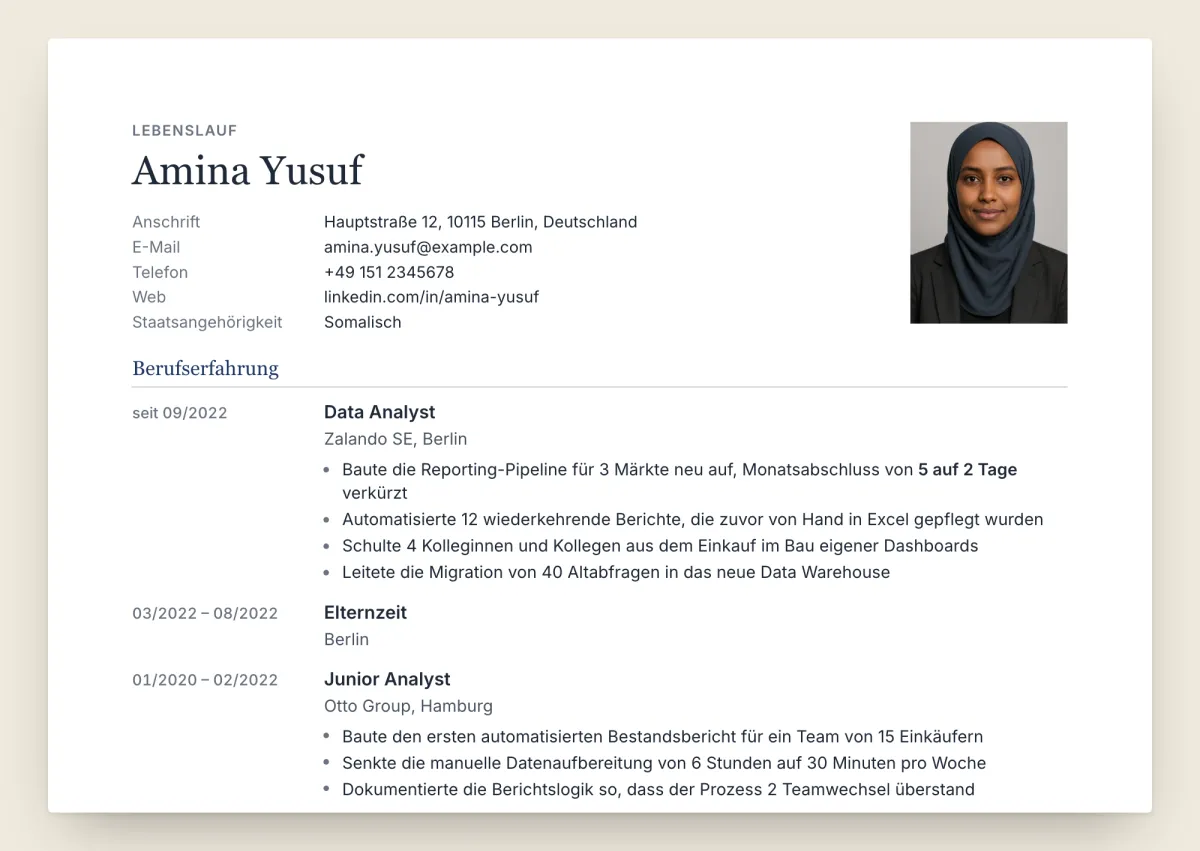
A gap named the German way, drawn by our builder from sample data (Classic design). Six months of parental leave between two jobs, as one line with its own dates.
The wording, gap by gap
Pick the line that is true for you. The German is what goes on a German CV; the English is for an English one.
- Parental leave: Elternzeit (Parental leave)
- Looking for work: Berufliche Neuorientierung (Career reorientation), or Arbeitsuchend, Weiterbildung in Excel und SQL if you also trained
- Moving to Germany: Umzug nach Deutschland, Anerkennung des Abschlusses (Relocation to Germany, recognition of my degree)
- Learning German: Intensivsprachkurs Deutsch (B1), Goethe-Institut (Intensive German course)
- Waiting for a visa: Vorbereitung der Einreise nach Deutschland, Deutschkurs A2 (Preparing the move to Germany, German course A2)
- Caring for a relative: Pflege eines Angehörigen (Caring for a family member)
- Illness, now behind you: Auszeit aus gesundheitlichen Gründen (Time out for health reasons). You give no diagnosis.
- Travel or a planned break: Auszeit, Reise durch Südostasien (Sabbatical, travel in Southeast Asia)
- Freelance or project work: Freiberufliche Tätigkeit als Übersetzerin (Freelance translator), with one bullet on a real project
If you did something in the gap that matters for the job, such as a course, a certificate or a volunteer role, add it as a bullet under the line. That turns a gap into evidence. If you did nothing in particular, the line alone is enough.
Gaps people worry about that are not gaps
- Overlaps. A course that ran while you worked, or a part-time job during your degree, simply sit next to each other. Overlap is fine.
- The months between your degree and your first job, if they stay under the two-month line.
- Studying. Your degree counts. It fills the timeline from its first month to its last.
Where to explain the rest
Most gaps need nothing beyond their line. When one does, because it is long or marks a change of career, the Bundesagentur's service for international applicants suggests explaining it proactively in the cover letter (Anschreiben) or in the interview. Keep it to one or two sentences that end on what you do now, not on the gap. Our guide to the German cover letter shows where such a sentence fits.
Prepare the spoken version too: one sentence, true, and ending in the present. "I took six months of parental leave and came back to analytics in September 2022" closes the subject.
What not to do
- Do not stretch the dates of a job. Employees in Germany are entitled to a written reference (Arbeitszeugnis) that states the type and duration of the work (Section 109 GewO), so stretched dates are easy to check and look worse than the gap.
- Do not invent a job. The same reason, and a far worse outcome.
- Do not switch to years only to make a gap disappear. Recruiters read years-only as exactly that.
Our post on the German CV mistakes that filter out internationals covers the other format traps.
Let the builder find them for you
The German CV Builder checks your timeline as you type. It flags any gap of more than three months between your entries before you download, so you can add the line it needs, and it writes every date as MM/YYYY for you. One CV is free, with a PDF and Word download. Check your CV for gaps.
Related on Ankommo
- German CV Builder: a free Lebenslauf maker that flags gaps in your timeline.
- German CV Format: every section of the German CV, in order.
- German CV Templates: ten designs, every one writing your dates as MM/YYYY.
Frequently asked questions
How long can a gap in a German CV be before I should explain it?+
The Bundesagentur für Arbeit advises naming any break of more than two months. Some recruiters only ask about longer gaps, but two months is the safe line: give every break beyond it one line in the timeline, with the dates as MM/YYYY.
How do I write a gap in German on my CV?+
As its own entry in the timeline, with dates and a short neutral label, for example 03/2022 – 08/2022 Elternzeit, or 01/2024 – 05/2024 Umzug nach Deutschland, Intensivsprachkurs Deutsch (B1). One line is enough; add a bullet only if you did something worth showing, such as a course or a certificate.
Should I explain a gap in the cover letter?+
Only if one line in the CV cannot carry it, for example a long break or a change of career. The Bundesagentur's service for international applicants suggests explaining gaps proactively in the cover letter or in the interview. Keep it to one or two sentences that end on what you are doing now.
Can I just stretch the dates of my last job to cover a gap?+
No. Your references (Arbeitszeugnisse) state how long each job lasted, so stretched dates are easy to spot and look worse than the gap itself. Name the gap honestly instead; a named gap is an ordinary part of a German CV.
Sources
- Bundesagentur für Arbeit: Den perfekten Lebenslauf erstellen (name breaks of more than two months and what you did in them)
- Bundesagentur für Arbeit (ZAV), International Services Spotlight 01/2026: explain gaps proactively in the cover letter or the interview
- Section 109 GewO: the written reference (Zeugnis) that states the type and duration of a job

Guide by
Abdullah
Creator of Ankommo · Based in Germany
I moved to Germany and built Ankommo to help others navigate the same process I went through. We offer 1-on-1 video consultations on visas, Ausbildung applications, citizenship requirements and settling in.
Book a 1-on-1 consultation