← Blog · 16 November 2026 · German CV · Lebenslauf · Job search
German CV Mistakes That Get Internationals Filtered Out
Eight German CV mistakes that cost international applicants interviews, from dates without months to silent gaps and vague German levels, and the fixes.

Most international CVs that go nowhere in Germany are not short on experience. They break the format a German recruiter reads in: dates without months, a gap with no line, a third page, a German level written as "conversational". Each of these takes minutes to fix, and the fixes below are the same checks our free German CV builder runs on every CV.
Why the format matters more in Germany
A German CV, the tabellarischer Lebenslauf, is a table. Dates sit on the left, entries on the right, and the newest comes first. The Federal Employment Agency (Bundesagentur für Arbeit) describes it as one to at most two A4 pages in tabular form, starting with the most recent section.
Because nearly everyone uses that shape, a recruiter reads the dates column before anything else and notices whatever does not fit. A résumé that tucks the dates away or leaves holes stands out for the wrong reason before anyone reads what you achieved. Our German CV format guide walks through every section in order. This post is about the mistakes.
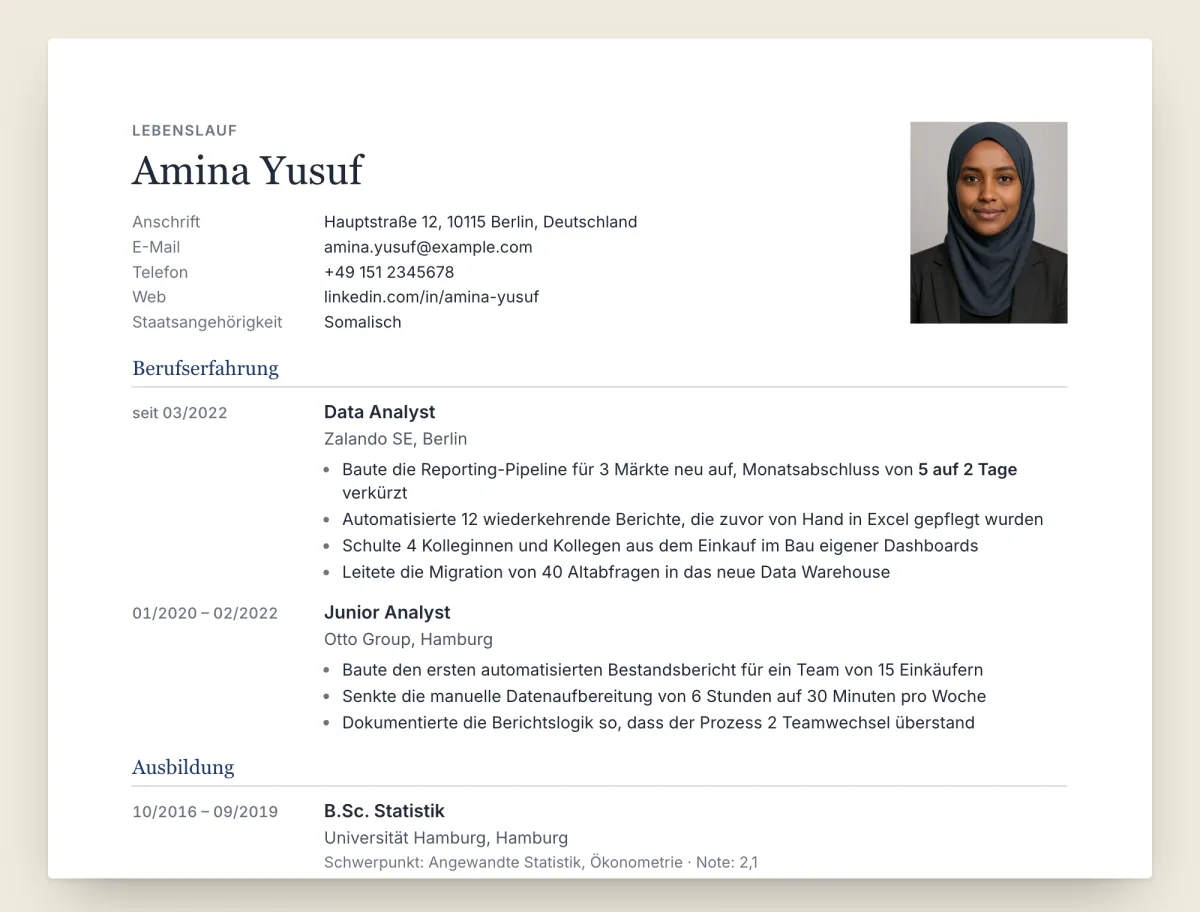
A Lebenslauf drawn by our builder from sample data (Classic design). Dates as MM/YYYY in their own column, the current role first, and a contact block a recruiter takes in at a glance.
1. Years without months
"2020 to 2022" can mean just over a year or three full years. Write every entry as month and year: 01/2020 – 02/2022, and "seit 03/2022" (since 03/2022) for the job you still hold. Years alone look like an attempt to hide a gap, whether or not there is one.
2. A gap with no line
The Bundesagentur's advice is to name any break of more than two months and say what you did in it, and to address gaps openly rather than hide them. Parental leave, a job search, a language course or the move to Germany each take one line in the timeline. Silence is what gets questioned. Our post on gaps in a German CV has the German wording for each case.
3. A third page
One page early in a career, two once you have several years of experience. When you run over, shrink older roles to a single line each instead of deleting them. A deleted job opens exactly the kind of gap mistake 2 is about.
4. "Fluent" or "conversational" German
German employers read language skills on the Common European Framework of Reference (CEFR), from A1 to C2. "Conversational" usually reads as lower than it is, and "fluent" invites a test in the interview. Write the level and, if you have one, the certificate: Deutsch: B2 (Goethe-Zertifikat, 06/2023). Give every other language a level too, and your first language as Muttersprache.
5. Leaving out what a German CV expects
A résumé written for the US or the UK often leaves out things a German recruiter looks for: a full contact block with your city, and the photo. The photo is optional by law, and the Bundesagentur's service for international applicants still notes that most employers expect one. Whether you add a photo to your German CV is your call, but make it on purpose. Our comparison of the German CV and the international résumé lists every other difference.
6. Translating your degree into a German one
Do not rename a Bachelor of Technology as a Diplom-Ingenieur. Keep the title exactly as your certificate states it and, if you know it, add the German equivalent in brackets. German employers can look up foreign degrees in anabin, the database of the Kultusministerkonferenz, and a title that does not match the certificate raises questions instead of answering them.
7. Sending the CV without the certificates
A German application (Bewerbung) usually carries three parts: the cover letter (Anschreiben), the CV and the Zeugnisse, meaning your degree certificates and references from previous employers. Employees in Germany are entitled to a written reference when a job ends (Section 109 GewO), so recruiters expect to see them. Ask employers abroad for a reference letter too. If the ad asks for a cover letter, our guide to the Anschreiben covers the structure line by line.
8. The wrong language
An English CV for a German-language ad tells the recruiter you may not be able to work in the language of the team. Send the CV in the language of the ad. Our post on choosing a German or English CV covers what changes between the two versions.
A five-minute check before you send
- Every date written as MM/YYYY, the current role as "seit".
- No break of more than two months without its own line.
- Two pages at most.
- Every language with a CEFR level.
- Degree titles exactly as on the certificate.
- The CV in the language of the job ad.
The German CV Builder does most of this for you. It writes dates as MM/YYYY, flags gaps of more than three months, counts pages on the real A4 print and scores the CV against German recruiting conventions. One CV is free, with a PDF and Word download and no card. Build your German CV free.
Still choosing a tool? Our comparison of CV builders for a German application checks eight of them against the same list.
Related on Ankommo
- German CV Builder: build the Lebenslauf in the format German recruiters expect, free for one CV.
- German CV Templates: all ten designs of the builder, and which suit which jobs.
- German CV Format: every section of the tabellarischer Lebenslauf, in order.
Frequently asked questions
What is the most common mistake on an international CV in Germany?+
Dates without months and gaps without a line. A German recruiter reads the dates column first, so an entry like 2020 to 2022 or an unexplained half year draws attention before your experience does. Write every date as MM/YYYY and give every break of more than two months one honest line.
How long should a German CV be?+
One to at most two A4 pages, which is what the Bundesagentur für Arbeit advises. One page fits an early career, two fit several years of experience. Shorten older roles to a single line each rather than deleting them, so that no gap appears in the timeline.
How should I write my German level on a CV?+
As a CEFR level from A1 to C2, ideally with the certificate and its date, for example Deutsch: B2 (Goethe-Zertifikat, 06/2023). Words like conversational or fluent are hard to judge and usually read as lower than the level you actually have.
Should I translate my degree title into a German one?+
No. Keep the title exactly as it appears on your certificate and add the German equivalent in brackets if you know it. Employers can look up a foreign degree in the anabin database, and a title that differs from the certificate raises questions instead of answering them.
Sources
- Bundesagentur für Arbeit: Den perfekten Lebenslauf erstellen (tabular, one to two A4 pages, newest first, breaks of more than two months named)
- Bundesagentur für Arbeit (ZAV), International Services Spotlight 01/2026: Bewerbungsverfahren in Deutschland
- Council of Europe: Common European Framework of Reference for Languages (CEFR), levels A1 to C2
- anabin (Kultusministerkonferenz): how foreign degrees are evaluated in Germany
- Section 109 GewO: the employee's right to a written reference (Zeugnis)

Guide by
Abdullah
Creator of Ankommo · Based in Germany
I moved to Germany and built Ankommo to help others navigate the same process I went through. We offer 1-on-1 video consultations on visas, Ausbildung applications, citizenship requirements and settling in.
Book a 1-on-1 consultation