← Blog · 16 November 2026 · German CV · Lebenslauf · Job search
German CV vs Résumé: What Changes for a German Application
A German Lebenslauf is not a translated résumé: dates in their own column, a full contact block, an optional photo, certificates attached. The differences.

A German CV (Lebenslauf) differs from a US or UK résumé more in shape than in content. It is a reverse-chronological table with the dates in their own column, it opens with a full contact block, it usually carries a photo, and it travels with your certificates. The achievements you would put on a résumé still belong on it; what changes is how they are laid out and what goes around them.
The differences, one by one
1. A table, not a free layout. The Bundesagentur für Arbeit describes the German CV as tabular, one to at most two A4 pages, starting with the most recent section. Dates sit in a column of their own, so a recruiter reads your timeline first. A skills-first or functional résumé that pushes dates to the end works against that habit.
2. Months on every date. Every entry carries month and year (03/2021 – 06/2023), and the current role reads seit 03/2022. Years alone read as hidden gaps.
3. No unexplained gaps. German recruiters expect every month accounted for. Any break of more than two months gets its own line, as our post on gaps in a German CV explains.
4. A full contact block. Name, postal address, phone and email under the title, often set out as a small table. The Bundesagentur lists date and place of birth in its example and calls nationality and family details voluntary; the AGG means you may not be disadvantaged on age or origin, so both are your choice.
5. The photo. Optional by law, still expected by most employers, according to the Bundesagentur's service for international applicants. A résumé for the US or UK normally has none. Our post on whether a German CV needs a photo covers the law and the practice.
6. Language levels on the CEFR scale. German, English and every other language with a level from A1 to C2, your first language as Muttersprache. Not "fluent", not "working knowledge".
7. A place, date and signature line. Traditionally the CV ends with Ort, Datum and your name. Here even the Bundesagentur's own pages differ: its newsletter for international applicants says to close the CV with the date and your signature; its general CV guide says a signature is not strictly necessary. For an online application, a place, date and typed name is the common middle ground.
8. Certificates instead of referees. Where a résumé says "references available on request", a German application attaches the documents: degree certificates and written references (Arbeitszeugnisse). Employees in Germany are entitled to such a reference when a job ends (Section 109 GewO).
9. A separate cover letter. The Anschreiben is its own page arguing why you fit this role; it is not a summary of the CV. Our guide to the German cover letter covers the structure.
10. No objective statement. A two or three line profile at the top is optional. A US-style objective ("seeking a challenging role") is uncommon.
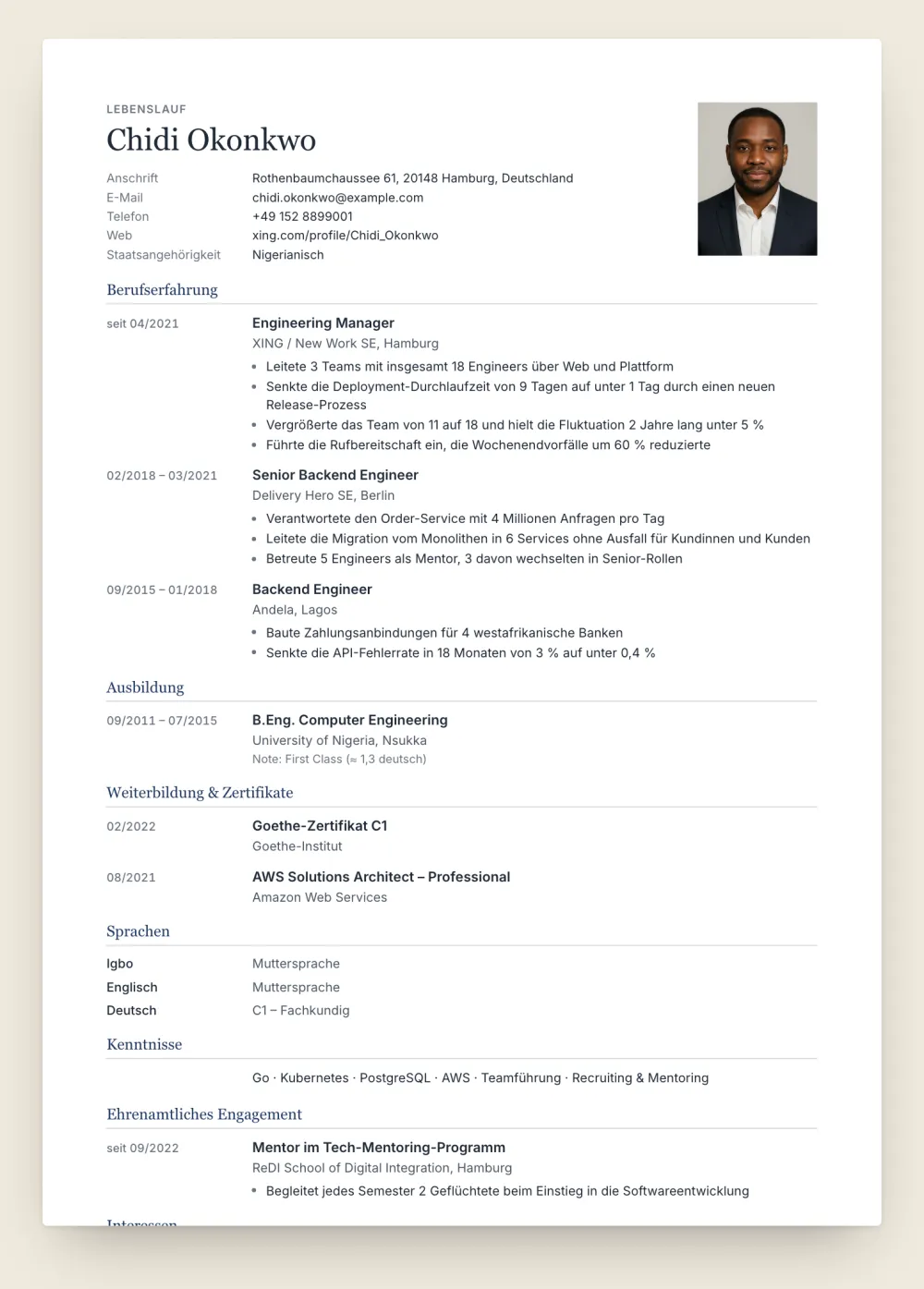
A senior engineer's Lebenslauf drawn by our builder from sample data (Classic design). The contact block, the dates column, the CEFR levels: everything above in one page.
If someone suggests a Europass CV instead, our comparison of the Europass CV and the German Lebenslauf explains when the EU format fits and when it does not.
What stays the same
- Achievements with numbers. "Cut deployment lead time from 9 days to under 1" works in Hamburg as it does in Houston.
- Tailoring. Every application gets the bullets that match its ad.
- Readability for software. When an employer screens with an applicant tracking system, a clean single-column layout is the safest choice; our German CV templates mark which designs suit it best.
- Honesty. Your Arbeitszeugnisse state how long each job lasted, so the dates on your CV must match them.
Turning your résumé into a Lebenslauf
- Add the month to every date and put the newest entry first in each section.
- Add a contact block with your full address.
- Give every language a CEFR level.
- Decide on the photo, on purpose.
- Close any gap of more than two months with one line.
- Cut to two pages; shorten old roles rather than deleting them.
- Add place and date at the end, and gather your certificates and references.
- Write the CV in the language of the job ad, as our post on choosing a German or English CV explains.
The German CV Builder writes your dates as MM/YYYY, offers every language on the CEFR scale, flags gaps of more than three months as you type, and lays the rest out in the German order. On the Career plan it also reads an existing résumé from a PDF or Word file into the German format. One CV is free with a PDF and Word download. Turn your résumé into a German CV.
Related on Ankommo
- German CV Templates: ten designs, and which are safest for applicant tracking systems.
- German CV Format: the German CV section by section.
- German CV Builder: build the Lebenslauf free, in German or English.
Frequently asked questions
Is a German CV the same as a résumé?+
It carries the same content but in a different shape. A German Lebenslauf is a table with the dates in their own column, newest first, a full contact block, usually a photo, and every month accounted for. A résumé is freer in layout and often leaves out personal details and the photo.
Can I send my US or UK résumé to a German employer?+
For an English-language role at an international company it can work. For most German employers, rework it into a Lebenslauf: add months to every date, put the newest entry first, add your contact block and CEFR language levels, decide on the photo, and keep it to two pages.
Do German CVs list references?+
Rarely as a list of referees. German applications attach written references instead, the Arbeitszeugnisse that employees in Germany are entitled to when a job ends (Section 109 GewO), alongside degree certificates. A line saying references are available on request is optional.
Does a German CV need a summary or objective?+
No. A short profile of two or three lines at the top is optional and can help a career changer, but many German CVs go straight from the contact block to work experience or education. A US-style objective statement is uncommon.
Sources
- Bundesagentur für Arbeit: Den perfekten Lebenslauf erstellen (tabular, one to two A4 pages, newest first, voluntary personal details, signature optional)
- Bundesagentur für Arbeit (ZAV), International Services Spotlight 01/2026: photo, two pages, date and signature, Europass
- Section 109 GewO: the written reference (einfaches and qualifiziertes Zeugnis)
- Section 7 AGG: the ban on disadvantaging applicants on the grounds in Section 1
- Council of Europe: Common European Framework of Reference for Languages (CEFR)

Guide by
Abdullah
Creator of Ankommo · Based in Germany
I moved to Germany and built Ankommo to help others navigate the same process I went through. We offer 1-on-1 video consultations on visas, Ausbildung applications, citizenship requirements and settling in.
Book a 1-on-1 consultation