← Blog · 23 July 2026 · Work in Germany · Immigration · Skilled Workers
Germany's Work-and-Stay-Agentur: The One-Stop Fix for Visa Delays, Explained
Germany's cabinet approved plans for a Work-and-Stay-Agentur: one digital platform for skilled-worker visas. What's confirmed and what to do now.
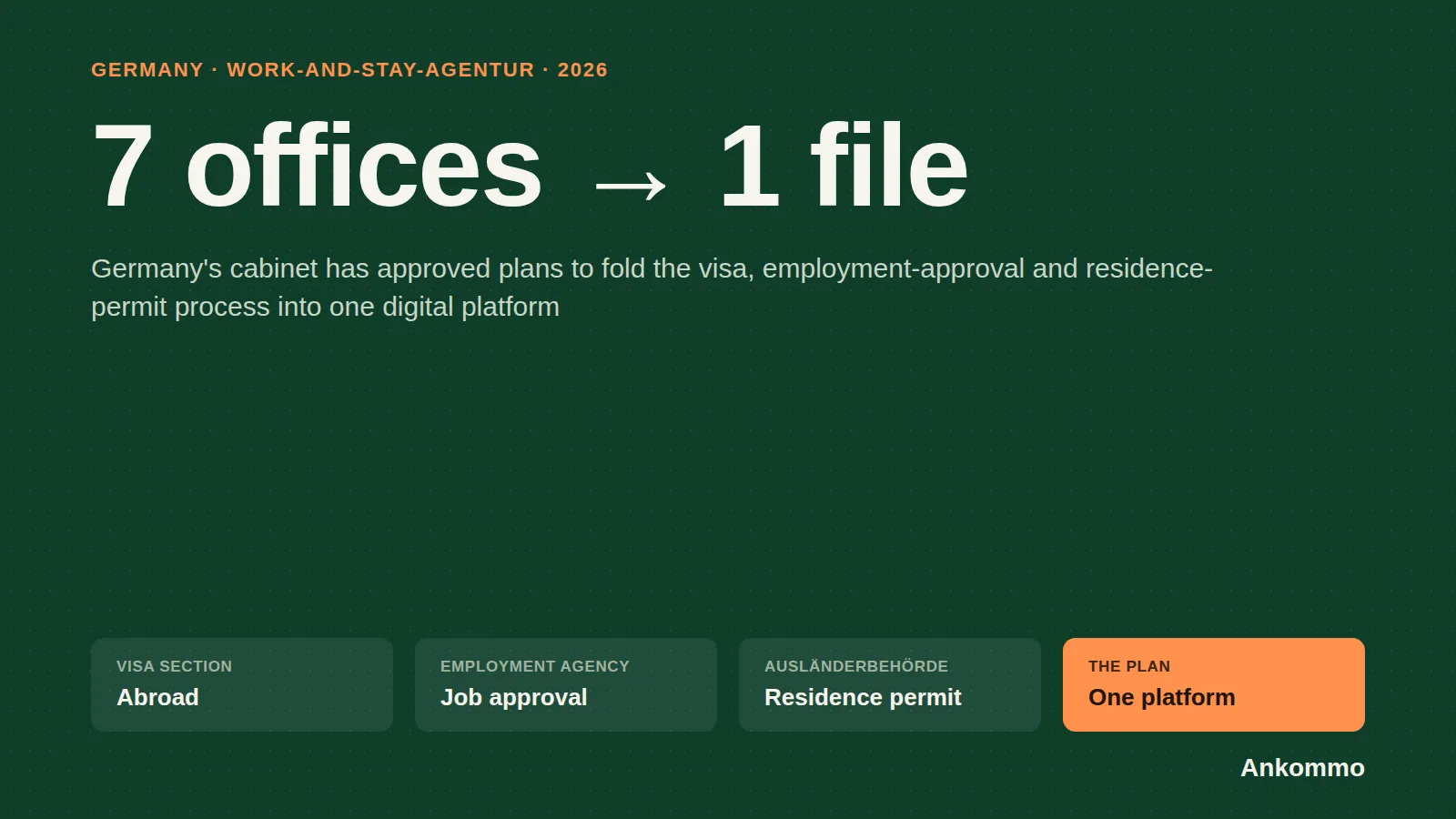
If you've ever applied for a German work visa, you already know the real obstacle isn't any single rule: it's that your application has to pass through a chain of separate offices, each with its own forms, its own queue, and no idea what the others are doing. The German cabinet has now approved the first step toward fixing that: a planned digital platform called the Work-and-Stay-Agentur (work-and-stay agency).
It isn't open yet. But if you're planning a move to work in Germany over the next few years, it's worth understanding what's actually been decided, and what's still just a plan.
The problem it's meant to solve
Today, a single skilled-worker visa application can involve at least seven different authorities: the German mission abroad that takes your application, the Federal Employment Agency (Bundesagentur für Arbeit) that has to approve the job and check pay and working conditions, the local immigration office (Ausländerbehörde) that issues the residence permit once you arrive, plus recognition bodies for foreign qualifications, in some cases the Foreign Office and Interior Ministry, and more. Each hop means resubmitting documents and waiting for the next office to pick up your file. (Bundesregierung; BMAS)
That fragmentation (not any single visa rule) is what's driven the long, unpredictable waits that anyone who's read a Germany-visa forum thread will recognize.
What's actually been decided
The federal cabinet has approved the Eckpunkte (the guiding principles) for building the Work-and-Stay-Agentur. That's a real, official step, but it's a policy decision, not a finished system. Labour Minister Bärbel Bas (SPD) led the proposal, developed together with the Interior Ministry and the Foreign Office. (Bundesregierung; BMAS)
Importantly, this isn't a brand-new government agency being bolted on top of the existing ones. It's being built jointly by the Federal Employment Agency and the Federal Foreign Office, with the goal of networking the offices that already exist (visa sections, the Employment Agency's approval step, and domestic immigration authorities) through one shared digital case file, rather than replacing them. (Bundesamt für Auswärtige Angelegenheiten)
The stated model is a "One-Stop-Government": you submit your documents once, and every office in the chain works from the same file instead of asking you to resend it at each step. (BMAS)
What's still just a plan
Here's the part worth being clear-eyed about: there is no Work-and-Stay-Agentur portal to apply through yet. As of this cabinet decision, the government's own timeline calls for a first draft law during spring 2026, with the underlying IT components going out to tender over the course of 2026. Rollout, by the government's own framing, happens gradually rather than all at once. (Bundesregierung; BMAS)
That gap between "cabinet approved the principles" and "system exists" is exactly where a lot of hype articles blur together speculation with fact: projected processing times, launch dates, and feature lists that go well beyond what any of the three official announcements above actually confirm. Treat anything more specific than "approved in principle, legislation planned for 2026" as a forecast, not a commitment, until the government publishes it directly.
How this is different from the Consular Services Portal
Don't confuse this with the Consular Services Portal, which is already live and mandatory for most national visa applications submitted at German missions abroad. That portal digitizes the first step, applying at the embassy or consulate. The Work-and-Stay-Agentur is aimed at the handoffs after that: Employment Agency approval and the domestic residence-permit process once you're in Germany. They're solving different parts of the same chain, and it's entirely possible to use the Consular Services Portal today while the Work-and-Stay-Agentur is still being built.
What to actually do right now
If you have a job offer and need to move on a real timeline, don't wait for this. Apply through the process that exists today:
- If you clear the salary threshold, the EU Blue Card remains the fastest standard route, with a clear path to permanent residency.
- If your foreign qualification needs work before it counts as equivalent, the recognition partnership visa lets you start working in Germany while that catches up, instead of waiting abroad.
- Whichever route you're on, budget real time for the current, multi-office process; the whole point of the Work-and-Stay-Agentur is that this process is still slow.
The bottom line
The Work-and-Stay-Agentur is a genuine, cabinet-approved commitment to collapse a seven-office visa process into one digital file, a real answer to the single biggest complaint about German work immigration. It just isn't built yet. Watch for the draft legislation and, when it lands, we'll cover exactly how to use it. Until then, the existing visa channels are still the ones that get you here.
Related on Ankommo
- EU Blue Card Germany 2026: Salary Thresholds & the Fast Track to PR
- Germany's Digital Visa Portal 2026
- Germany Visa Checker
Figures verified against the official sources below as of July 2026. This is a planned reform, not a live system, so always confirm current status against the linked official pages before making decisions.
Frequently asked questions
What is the Work-and-Stay-Agentur?+
It's a planned central digital platform for skilled-worker immigration to Germany, approved in principle by the federal cabinet. It's meant to replace the current setup (where a single visa application touches at least seven different offices) with one digital process where you upload your documents once.
Is the Work-and-Stay-Agentur open yet?+
No. As of mid-2026, the cabinet has only approved the guiding principles (Eckpunkte) for building it. A first draft law was planned for spring 2026, with the underlying IT infrastructure due to be tendered during 2026. There's no application portal yet, so keep using the existing visa and Ausländerbehörde process.
Which offices does the Work-and-Stay-Agentur combine?+
It's built jointly by the Federal Employment Agency (Bundesagentur für Arbeit) and the Federal Foreign Office, in coordination with the Labour and Interior Ministries. It's designed to network visa sections abroad, the Employment Agency's approval step, and domestic immigration authorities (Ausländerbehörden) through one shared data hub, rather than creating a brand-new authority.
Sources

Guide by
Abdullah
Creator of Ankommo · Based in Germany
I moved to Germany and built Ankommo to help others navigate the same process I went through. We offer 1-on-1 video consultations on visas, Ausbildung applications, citizenship requirements and settling in.
Book a 1-on-1 consultation